Monday, May 21, 2012

 Elder and Hermana Nelson with Elder Amos Mendosa.
Amos is the first young man to serve a mission from
 the jungle city of Nauta Peru.  He was set apart today as a full
time missionary to serve in the Boliva La Paz Mision.   He has been
a member for little over a year.  The Nelsons served in Nauta for 
14 months helping to establish a branch of the church there. 
Amos attended Hermana Nelson's seminary class each day to
learn the gospel. 

From this young man we learned a great lesson. On this day when he was set apart, he could not thank us and the Nelson's enough for all he has been given in his life.  Really we have just guided him and
   the Lord and the gospel of Jesus Christ have given him a new life. 
This young young man comes from the humblest of circumstances,
 his home has dirt floors and very few furnishings but his heart was full of 
gratitude and thanksgiving. 

From the one who has the least of this world's pocessions came
the most words of gratitude. 
What a powerful lesson he taught all of us this day.

Elder Mendoza will enter the CCM this Wednesday.

In our apartment you can see
that we have flags from all the countries our
missionaries are from. 


This month we are doing zone conferences.
I hope some of you moms can find a picture of your missionary.
Zona Tahuantinsuyo 
Zona Carabayllo 
 Zona Independencia
 Zona Pucallpa
Hemrnas:  Grow, Arias, Vasquez y Melo
and Elder Smith in the background 
Zona Tarapoto
 Zona Yurimaguas
 Zona Moyobamba

 I had to laugh when these elders  (Whiteside, Haderlie, Hughes
 and Van Valkenburg started looking
in my cupboards to see if there was any food.  Boys
will be boys!!!!!   They were in luck I had brownies and ice cream
on hand and they were pretty happy.

Life in Peru is always quite interesting.
Pulled pork sandwiches anyone.  I'll have
to keep this idea in mind next time I entertain. 
Fresh pork pulled right from the pig.
I really couldn't believe what I was seeing. 


Lima has some wonderful spanish architecture.
These cathedrals are located near the central plaza.


 There is also a modern side to Lima.
The Westin hotel is probably the newest addition.
From where we live it takes us about an hour
 to travel to the mission office.  The president also
has a working office in our apartment. 

Monday, May 14, 2012

Another region in Lynette's mission was the city of Puno located in
southern Peru.  This was our first stop on our five day trip returning to her mission.  Puno is perhaps best known for Los Uros, or the floating islands of Lake Titicaca.  Lake Titicaca is the largest lake in South America and also the highest lake at 12500 ft.  We took altitude pills so we wouldn't get sick.  This lake borders Peru and Bolivia.  About 3000 people live on man make islands on Lake Titicaca.  In the Lima North Mission one of our missionaries is from Los Uros.  Here is a picture of Elder Charca's father and older brother Omar.  Omar was the first missionary to serve a mission from Los Uros.  There is a small branch of the church located on one of the islands and full time missionaries travel to the islands each day to work.  

Elder Charca's dad and brother, Omar picked us up in their small boat and it took us about 20 minutes to travel to the islands.  There are about 70 man made islands and about 350 families live on these islands.  Everything on
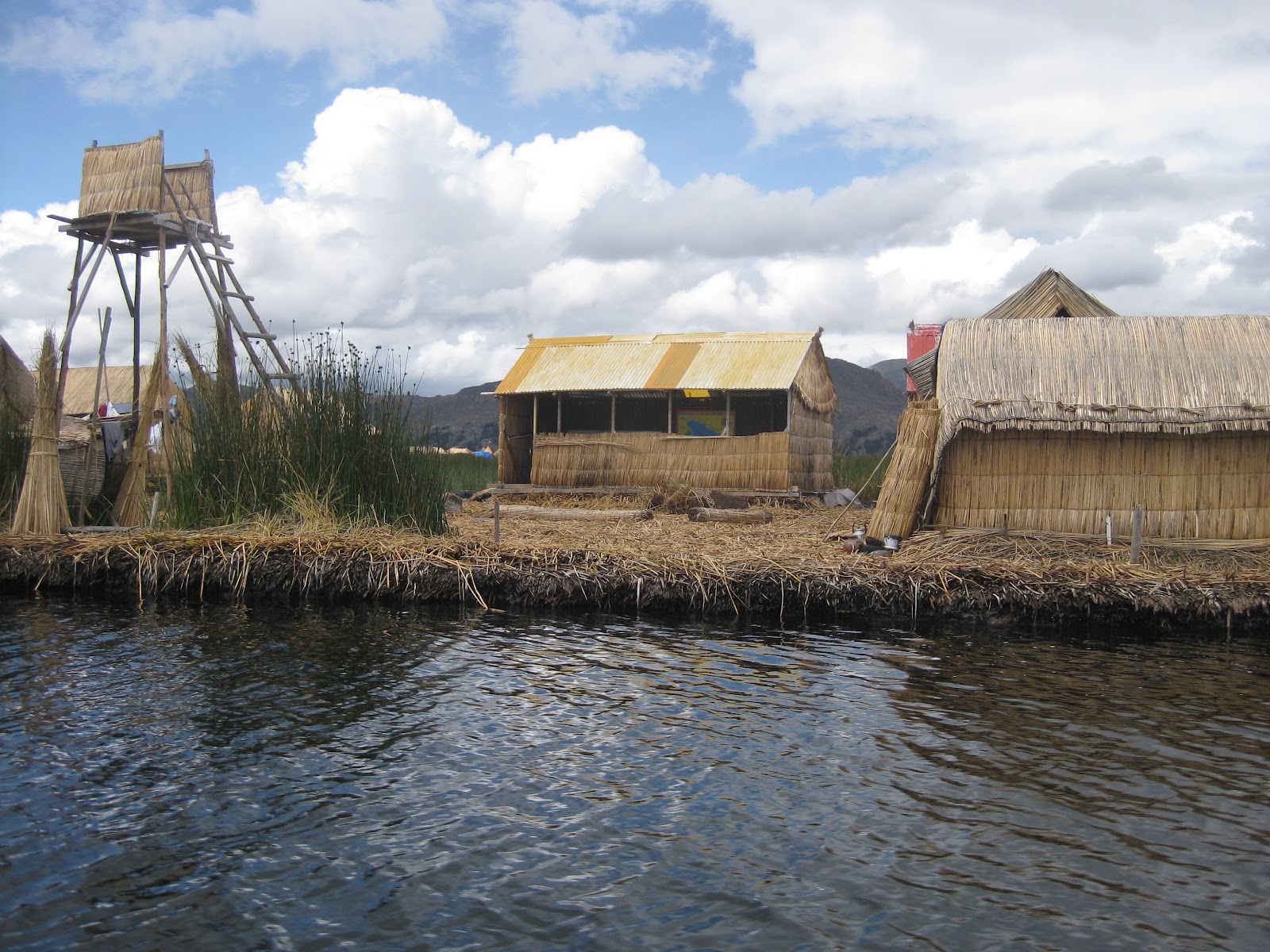
these islands is made out of the totora reeds that is harvested from the shallows of the lake bed.  These islands were originally built to prevent attacks by the aggressive Incas.  Today people continue to live here because of family tradition and ecomomic reasons.   
This is the island Elder Charca's family lives on.  Usually 5-7 families live
on an island.  They made this island 12 years ago.  Each island
had a watch tower.  Before cell phones this is how they would
communicate with one another. 
Each island has small buildings made out of reeds.  Each year these buildings are replaced as the elements deteriorates the reeds.
Here Elder Charca's dad tells us how the islands are created
Several root balls of the reeds are tied together.  Eventually the roots grow together forming a  mass that reeds can be stacked upon.  They stack about 3 meters of reeds on top of this floating root mass.  This mass floats in about 30 meters of water.
This is Elder Charca's family.  He also has two sisters who
were attending school while we visited.  Their means of livelihood
is fishing and tourism.  The men fish and create products out of
reeds and the woman create stitchery products. 
This is the kitchen on the island. The base
is a big stone slab.   They have to be very careful that
they don't catch the reeds on fire as they cook. 
Solar panels were installed about five years ago so they now
have one light bulb inside their buildings.  Before this time they used
a type of lantern. 
Elder Charca's mom displaying her stitchery. 
Each piece of stitchery tells a story.
A view fromt the watch tower of the other islands.
Elder Charcs'a aunt and uncle.  Elder Charca has a smile
just like his uncle.
We were able to travel to the island that has a branch of the church.  All the
buildings are made of reed.,
This is the main building they use for sacrament.
There is a separate building for relief society, primary and
young men and young women's.  Someday they hope for a
more permanent building.  About seventy people are
members of this branch.  A branch of the church is formed
when an area is being opened to the church.  Once enough members
attend a ward is formed. 
Here you typical houses and a little garden area.  They are able to grow a few potatoes but all other items are purchases in Puno.  Their diet consists  mainly of fish and vegetables. 
This family lives on the same island as the branch of the church. 
He has served as a member of the branck presidency. 
We were so grateful to the Charca family for the time
they took to give us a tour of their island.  It
truly was a once in a life time experience
to experence their way
of life.


Saturday, May 12, 2012

I was given permission to travel back to my daughter
Lynette's mission for five days.  In this post I want to share some of the sites  we visited.  The highlight of our trip was visiting the people she taught.
   Here we are in Cusco with her President,  President Calderon
and his lovely wife.  I am so grateful for their influence in
her life.  It puts perspective on my role in the lives
of the young people we serve with. 
Cusco was the center of the great Incan Empire, that is until the Spanish conquered the city.
Here you can see the black stones the Incas used to build their
sun temple.  The Spaniards were unable to destroy their stone work
so they built their churches on top of the Inca ruins.
The Incans were master craftmen with stone.  Each stone fits perfectly
together, so tightly that you can't slide a knife in between the stones. 
Their engineering ability to move these enormous stones is amazing.
All throughout the sacred valley of the Incas you find this kind of stone work.   
From Cusco we traveled to a pre Incan sight named Chincheros.
When you enter this community it is like you go back in time
100 years.  Chincheros is a very communal society in that everyone helps
their neighbors in the planting and harvesting of crops.  They only
grow enough for their needs and sell and trade amongst one another.  This is an agricultural community and no tractors are found here.  Fields are plowed with oxen and loads are carried out of the fields on the backs of burrows.  Most homes here do not have running water or electricity.   


The women in Chinceheros are known for their weaving ability.  We had
the opportunity to meet a group of women in a near by pueblo that demonstrated the weaving process to us.  First the wool is harvested by hand from, sheep or alpaca.  Seeds, plants and berries are gathered to
dye the fibers.
After the wool is sheered, it has to washed. Here this woman is using a root she has harvested to clean the raw wool.  It was amazing to see her break open the root of this plant with a rock and obtain a soap like product from it.  In the soapy water she washed the wool.  Amazingly it came out pure white.  The white wool is then dyed to make different colors of yarn.   
Here are some of the gound up plant seeds they use for dye.
The moss from trees makes a beautiful gold yarn.
These tiny berries are harvested to make a blue yarn.
The raw fiber is cooked with the dye for 45 minutes.
Look at the beautiful colors these plant products yield.
Amazing!

After the fibers are dyed they are stretched on a homemade loom and the weaving begins.  This is tedious work. It takes them hours to create a beautiful piece of fabric.  Their skill and work is amazing. 
These are the ladies that gave us a wonderful demonstration of their skill and art. They pass this art down from generation to generation.  They were so gracious to us.  Most of them spoke Quechuen.  They were delighted we came to their pueblo and admired their work.  I wish we could have bought something from everyone of them they were so proud of their work.  It was truly a work of art.   
All the wool is hand spun.  In this pueblo you see women walking everywhere spinning their fiber. 

 This is not as easy as it looks.
These women are precious.   
As they walk they spin.
This is the church the Spanish built in Chincheros it dates
back to the 16th century. 
Once again you see that it is built upon Inca ruins.
Outside the church the hillside is covered in terraces. 
The Incas build terraces to stablize
the steep hillsides and to reclaim part of the land for farming. 
All thoughout the valley of the Incas you see this kind of terracing. 
Despite years of earthquakes their work still stands. 

Urubamba is the city  Lynette served in for nine months.  
It is located in the heart of the sacred valley of the Incas.  What
a privilege for her to serve here.  The valley is surrounded by towering mountains.  On her preparation days she and her zone loved discovering many of the ruins in this valley. Urubamba is about one hour from Cusco.  The drive is beautiful.!

The people in Urubamba are amazing. They were so exicted to see Lynette.  The greatest experience of our trip was to see the great love these people had for Lynette.   For all you missionary parents that read this blog this is how converts feel about your sons and daughters. Your sons and daughters have brought the gospel of Jesus Christ into their lives and they will always love your missionary for helping them come unto Christ.   
 The lady with glasses is Karen, she is a new convert of less than a year.  Her daughter to her right is a return missionary.
 The wife of the district president, she was due to have a baby any day.
 To Lynette's right is the relief society president and on her left
is the relief society president's sister who is a new convert.

While in Urubamba the members treated us to a family home evening.
They were delighted Lynette would return to see them. 
I am grateful to the area presidency for allowing me to have
 this experience with my daughter.  

Peru is a very diverse country.  It consists of  high sierra like Cusco, coastal desert like Lima and the selva (or jungle region) like Iquitos.   With so much diversity there is somthing for everyone to see.  But the very best part is the love of the Peruvian people.  I have never met a more kind and loving people.  Despite their humble living conditions there is much we can learn from them.     


Tuesday, May 8, 2012


This is the Lima Peru Temple.  Families are sealed together for time and all eternity here. 
The building to the right is new.  This building houses missionary couples
that are serving in the temple and the lower floors provide economical housing for those
who have traveled a long distance to attend the temple.

This is our latest group of missionaries to depart the mission.  They leave with strong testimonies of Jesus Christ and a desire to go home and continue to serve others and the Lord.  I love
their smiles. 

Our latest group of missionaries to enter the mission.  They come from many different countries.  In this group is our first missionary from Honduras.  All come from from different backgrounds and experiences but the Gospel of Jesus Christ unites us all.  The Lord
blesses these new Americans to learn a new language quickly. If only the language would come to me as quickly.   Right now we
have about 200 missionaries in our mission.

Elder Essig has been serving as an assistant to the president, he is a great young man!  He will finish his mission training a new missionary.
He and his companinon travel with us to participate in and to help train
 other missionaries.  These young men take care of a lot of details so the
president can focus on the needs of the missonaries. 
 i

Pizza anyone?  Elder Huaiquimilla, Elder Essig, Elder Hendricks and
Elder Crump  are just about ready to provide lunch to the new missionaries. 
Pizza is always a hit!

When new misisonaries arrive each is paired with a trainer for the
first twelve weeks.  Trainers are some of our best missionaries.
Thanks Elder: Ortega, Sepulveda, Clouse, Olguin, Hernandez, Arias, Cifuentes and Purvis.
Thank you for your service Elders!


Elder Ortega and  Elder Anderson who is new are off to their area.
Let the journey begin!!!!

Part of the journey for the Latino missionaries is to have the opportunity to
learn English.  Here Elder Cespedes takes his English test.  The test consists of a oral conversation online that is evaluated in the US.  Each Elder who completes the
exam is given a certificate certifying their level of proficiency.  They can
present this certificate to employers at home.  For many of them this opens doors
to better employment.